
PROF Learning Center
Module 4: Reflect
Turning Travel Into a Learning System
Travel will never be perfect.
Flights get delayed. Meetings run late. Hotel gyms vary wildly.
But travelers who stay healthy long-term do something different:
They reflect on each trip and use the experience to improve the next one.
Reflection is the step that turns travel from a disruption into a continuous improvement process.
In this module, you’ll learn how to:
• evaluate your travel routines
• identify what worked and what didn’t
• turn every trip into a better strategy for the next one
Reflection is what makes the PROF cycle repeatable and powerful.
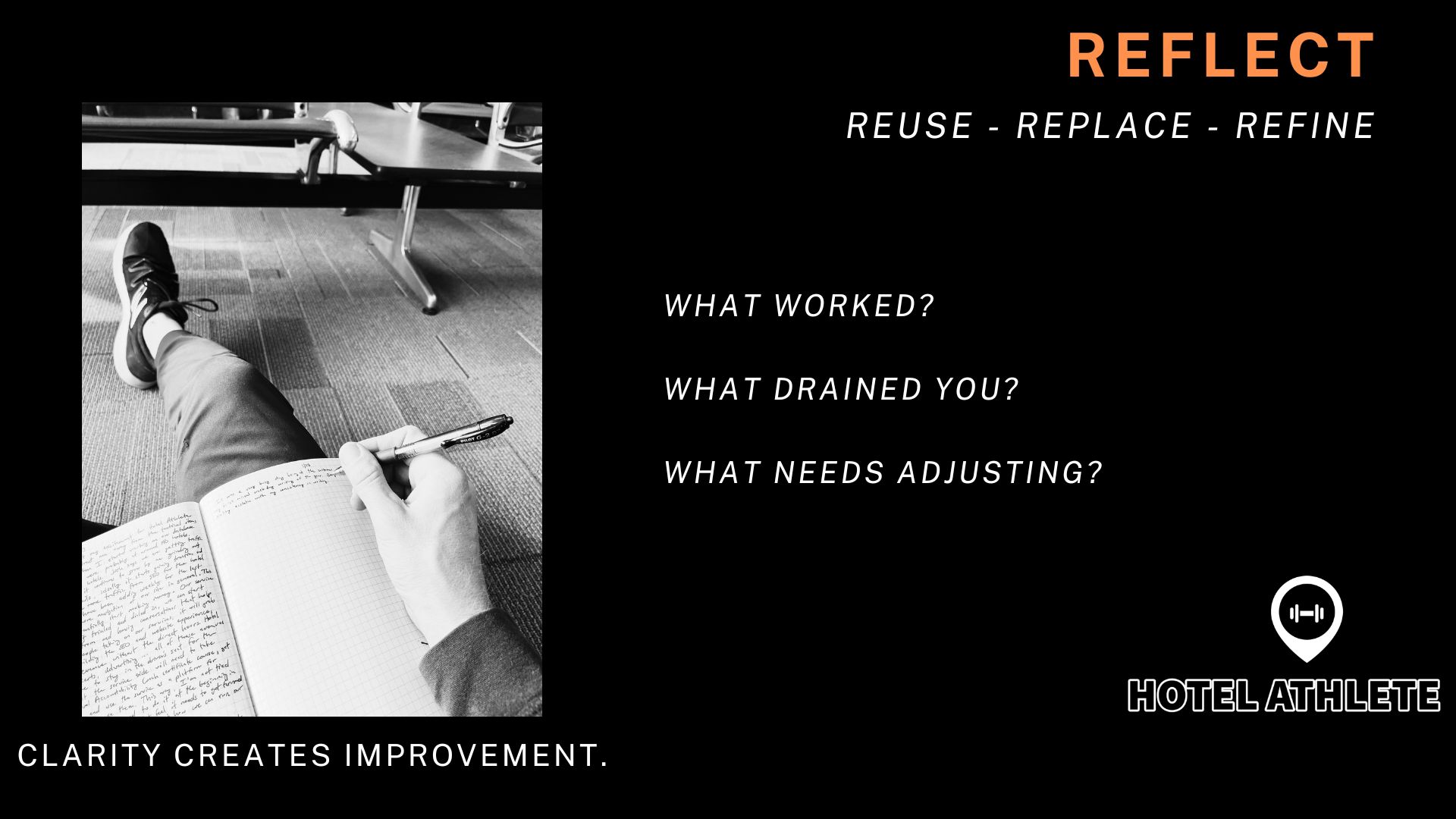
Section 1 — Why Reflection Matters for Travel Health
Most travelers approach health reactively.
A trip disrupts routines, and they simply try to reset once they return home.
But high-performing travelers do something different:
They treat every trip like data.
Instead of asking:
“Did I stay healthy during this trip?”
They ask:
• What worked well?
• What made healthy choices easier?
• What made them harder?
These answers reveal patterns that help travelers improve their routines.
Over time, small insights lead to major improvements in consistency.

Homework
Think about your last business trip.
Answer these three questions:
1️⃣ What healthy habit worked well during that trip?
2️⃣ What habit became difficult or inconsistent?
3️⃣ What factor influenced that difference?
Write down your answers before continuing.
Section 2 — Identifying What Actually Worked
Many travelers only focus on what went wrong during trips.
But reflection is most valuable when you identify what worked.
This helps you repeat successful strategies in the future.
Examples:
Maybe you discovered:
• a hotel with a great gym
• a morning workout routine that worked well
• a reliable travel breakfast option
These wins become repeatable systems.
The goal of reflection is not criticism.
It is recognition.
Homework
Think back to your most recent trip.
Complete this sentence:
The healthiest decision I made during that trip was:
Why did it work?
What conditions made it easier?
Section 3 — Recognizing Travel Friction
Every traveler experiences friction points.
These are the moments where healthy habits become difficult.
Examples include:
• arriving late to the hotel
• limited gym equipment
• long meeting schedules
• airport food environments
Instead of ignoring these challenges, reflection helps you identify patterns.
Once you see the patterns, you can begin to design solutions.
For example:
If hotel gyms frequently lack equipment, you may begin selecting hotels based on verified gym equipment.
If evening workouts often get skipped, you may move training to the morning.
Reflection turns obstacles into optimization opportunities.
Interactive Exercise
Complete the Travel Friction Audit.
Which of these situations commonly disrupts your routine?
☐ Long travel days
☐ Late hotel check-ins
☐ Limited hotel gym equipment
☐ Unpredictable meal options
☐ Fatigue from meetings
☐ Early flights
Now ask yourself:
Which one happens most often?
Write your answer below:
This friction point will become the focus of your next optimization step.
Section 4 — Turning Reflection Into Strategy
Reflection only works if it leads to action.
Once you identify what worked and where friction occurs, you can begin making small adjustments.
Examples:
Reflection insight:
Evening workouts often get skipped.
Optimization:
Train before breakfast instead.
Reflection insight:
Airport meals lead to poor choices.
Optimization:
Pack simple travel snacks.
Reflection insight:
Hotel gyms lack equipment.
Optimization:
Choose hotels using a verified gym database.
Each improvement may seem small.
But over time, these adjustments build a personal travel health system.
Interactive Exercise
Your Post-Trip Reflection
After your next trip, answer these four questions.
What worked well?
What made healthy habits easier?
What created friction?
What is one small adjustment for your next trip?
This simple reflection process turns travel into a continuous improvement loop.
Section 5 — Reuse, Replace, Refine: Turning Reflection Into Action
Reflection is valuable, but only if it leads to better decisions.
After evaluating a travel experience, the next step is deciding what to do with what you learned.
A simple way to do this is through three questions:
Should I reuse this?
Should I replace this?
Should I refine this?
These three options help turn reflection into clear adjustments for the next trip.
Reuse: Repeat What Worked
If something worked well during your trip, the simplest strategy is to repeat it intentionally.
Many travelers accidentally discover strategies that make healthy travel easier.
Reflection helps you identify these wins so they can become repeatable systems.
Examples of Reuse
Hotel Selection
You stayed at a hotel with a well-equipped gym.
Reuse strategy:
Add that hotel to your preferred travel list.
Workout Timing
A morning workout helped you start the day energized.
Reuse strategy:
Schedule morning training sessions on future trips.
Reliable Travel Meal
You found a simple breakfast option that kept you full and energized.
Reuse strategy:
Make that meal your go-to travel breakfast.
Walking Between Meetings
You realized short walks helped maintain energy.
Reuse strategy:
Build movement breaks into your travel schedule.
Replace: Change What Didn’t Work
Some travel habits simply don’t support your goals.
Reflection helps identify patterns that consistently create friction.
Instead of repeating them, the better strategy is to replace them with a better option.
Examples of Replace
Evening Workouts
Evening workouts were repeatedly skipped due to long workdays.
Replacement strategy:
Train in the morning instead.
Airport Food Choices
Airport meals often lead to low-energy food choices.
Replacement strategy:
Pack simple travel snacks before leaving home.
Low-Quality Hotel Gyms
You stayed at hotels with limited equipment.
Replacement strategy:
Choose hotels with verified gym equipment.
Long Periods of Sitting
Extended sitting left you stiff and fatigued.
Replacement strategy:
Schedule short walking breaks during travel days.
Refine: Improve What Almost Worked
Sometimes a strategy works partially, but could be improved.
Instead of abandoning it completely, you can refine it.
This often leads to the most powerful improvements because the foundation is already working.
Examples of Refine
Short Hotel Workouts
You completed workouts but felt rushed.
Refinement strategy:
Use simple 10–15 minute circuits designed for travel.
Sleep During Travel
You slept poorly during trips.
Refinement strategy:
Adjust your evening routine or room environment.
Workout Consistency
You trained once during a trip but missed additional sessions.
Refinement strategy:
Schedule two shorter workouts instead of one longer session.
Hotel Gym Selection
You found a decent gym, but equipment was limited.
Refinement strategy:
Look for hotels with heavier dumbbells or expanded equipment.
The Reflection Decision Loop
After every trip, ask three simple questions:
What should I reuse?
What should I replace?
What should I refine?
This turns travel from a disruption into a continuous improvement system.
Over time, these small adjustments create a travel routine that works in real-world conditions.
Homework
Think about your last trip.
What is one habit or decision that worked well?
Should you reuse it intentionally next time?
Write it down:
Homework
Think about one friction point from a recent trip.
What habit or situation should be replaced with a better strategy?
Write your answer:
Homework
Think about a travel habit that almost worked.
What small change could make it work better?
Write your refinement:
Module 4 Key Takeaways
Reflection transforms travel into a learning system.
Instead of restarting after every trip, you gradually build strategies that work in real travel environments.
Remember:
• Identify what worked
• Recognize friction points
• Adjust your strategy for the next trip
Small improvements compound into long-term consistency.
Module 4 Quiz
Looking Back On Your Trip With Purpose
Test your understanding of the Reflect step in the PROF cycle.
What Comes Next
Reflection helps you understand your travel experiences.
You’ve identified what worked, where friction occurred, and how your habits responded to the realities of travel. But insight alone doesn’t improve future trips unless it leads to intentional changes.
This is where the next step of the PROF framework comes in.
Optimize is about turning reflection into better strategy.
Instead of approaching each trip the same way, you begin making small adjustments that improve your environment, routines, and decisions. These changes might include selecting hotels with better gyms, adjusting workout timing, planning movement during travel days, or preparing simple nutrition strategies that support your energy.
Over time, these small improvements compound. What once felt like a constant disruption becomes a system that works with your travel schedule rather than against it.
In the next module, you’ll learn how to use the insights from reflection to optimize your travel routines, environment, and decision-making for future trips.
Next Module
Module 5: Optimize
Learn how to turn travel insights into smarter strategies for workouts, hotel selection, and daily routines on the road.
MODULES
Module 1 — The Travel Health Problem
Why traditional workout plans fail during travel.
Module 2 — The PROF Framework
Understanding the cycle that powers healthy travel.
Module 3 — Perform
How to train effectively in unpredictable environments.
Module 4 — Reflect
The fastest way to improve your travel routine.
Module 5 — Optimize
Small adjustments that dramatically improve travel health.
Module 6 — Fuel
Nutrition and recovery strategies for life on the road.
Module 7 — Travel Fitness Systems
Build repeatable workout systems that adapt to your environment.
Module 8 —
Choosing the Right Hotel Gym
A strategy to choosing your gym around your plan.
Module 9 — Travel Nutrition Systems
Creating repeatability and reducing decision fatigue.
Module 10 — Travel Recovery
The essential focal points to allowing your body to maintain its energy during travel.