PROF Learning Center
Module 8: Choosing the Right Hotel Gym
When you travel, your training environment changes constantly.
Some hotels offer full fitness centers with racks, machines, and functional space. Others may only provide a treadmill and a few light dumbbells.
The key to staying consistent is learning how to quickly evaluate a hotel gym and understand what type of training it supports.
Instead of asking:
“Is this a good gym?”
A Hotel Athlete asks:
“What type of workout can this space support?”
In this module, you’ll learn how to:
• evaluate hotel gyms before your trip
• assess equipment quickly when you arrive
• identify what types of workouts the space supports
• adapt your training plan when equipment is limited

Section 1 — Why Hotel Gyms Vary So Much
Hotel gyms are designed with different priorities depending on the type of property and the guests it serves.
Some hotels prioritize:
• general wellness for business travelers
• convenience for short stays
• space efficiency in urban locations
This means the available equipment can vary widely.
You may encounter:
• full commercial gyms
• small fitness rooms
• cardio-only setups
• minimal equipment spaces
Understanding this variation helps you approach hotel gyms with flexibility instead of frustration.
The goal isn’t to find the perfect gym.
The goal is to recognize what the gym allows you to do.

Reflection
Think about the last hotel gym you used.
• What equipment was available?
• Did it support the type of workout you planned?
• Did you adapt your workout or skip training altogether?
Recognizing these past experiences helps you begin approaching hotel gyms with flexibility instead of frustration.
Homework
On your next trip, take a quick photo or mental inventory of the hotel gym equipment.
Try to identify:
• cardio machines
• strength equipment
• open movement space
This simple awareness exercise helps you begin evaluating gyms quickly and confidently.
Section 2 — The Hotel Athlete Free Weight Level System
One of the fastest ways to evaluate a hotel gym is to look at the heaviest dumbbells available.
Why?
Because the maximum dumbbell weight usually determines the strength training potential of the gym.
A gym with dumbbells that only go to 25 pounds supports a very different workout than one with dumbbells up to 100 pounds or a full barbell rack.
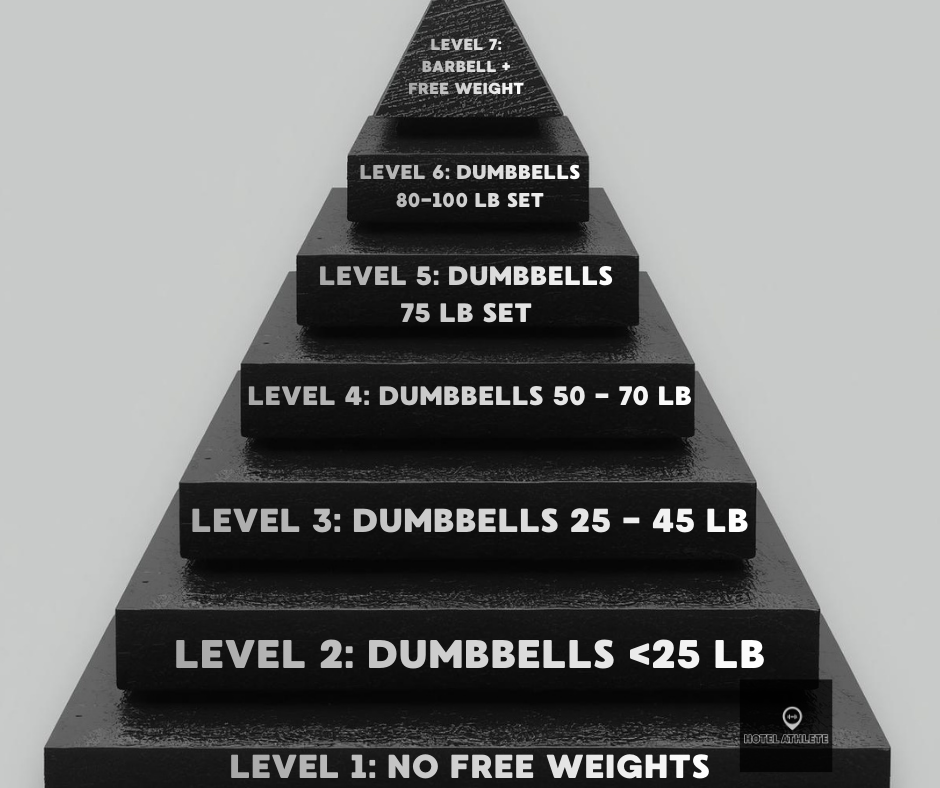
To make evaluation simple, the Hotel Athlete system classifies gyms into seven levels based on the free-weight ceiling.
Level 1 — No Free Weights
Equipment may include:
• treadmills
• bikes
• elliptical machines
• yoga mats
Training focus:
• conditioning
• mobility
• bodyweight training
Level 2 — Dumbbells Under 25 lbs
Typical equipment:
• light dumbbell sets
• adjustable bench
• cardio machines
Training focus:
• higher-rep strength work
• bodyweight + dumbbell circuits
• accessory movements
Level 3 — Dumbbells 25–45 lbs
Typical equipment:
• moderate dumbbell range
• benches
• cardio machines
Training focus:
• full-body dumbbell workouts
• unilateral strength work
• conditioning circuits
This is one of the most common hotel gym setups.
Level 4 — Dumbbells 50–70 lbs
Typical equipment:
• heavier dumbbell sets
• benches
• possible cable machines
Training focus:
• traditional strength training
• progressive overload
• upper/lower splits
At this level, most travelers can complete very effective strength workouts.
Level 5 — Dumbbells 75 lbs
Typical equipment:
• full dumbbell rack up to 75 lbs
• benches
• cable or selectorized machines
Training focus:
• heavier compound movements
• traditional strength programming
Level 6 — Dumbbells 80–100 lbs
Typical equipment:
• very heavy dumbbells
• benches
• machines or cables
Training focus:
• heavy dumbbell strength work
• advanced strength training
These gyms are less common but excellent for serious training while traveling.
Level 7 — Barbell and Rack
Typical equipment:
• squat rack or power rack
• barbells
• weight plates
• full dumbbell rack
Training focus:
• full strength programming
• barbell training
• traditional gym workouts
This level represents a complete training environment, similar to a commercial gym.
Why This System Works
The free weight ceiling gives travelers a quick, reliable indicator of training potential.
Even if machines vary between hotels, the dumbbell range tells you immediately what type of strength work is possible.
Reflection
Think about the hotel gyms you’ve used during past trips.
What was the heaviest dumbbell available?
That simple question often reveals the true training capability of the space.
Interactive Exercise
Based on the below equipment description lists, identify what Hotel Athlete Level gym it is. (Answers at end)
Example 1
-Treadmill
-Elliptical
-Peloton
-Dumbbell sets 5-30 lb
-Balance ball
Level _______________
Example 2
-Cable crossover machine with pullup bar
-3 Treadmills
-Rower
-Medicine balls
-TRX straps
Level _________________
Example 3
-2 Treadmills
-Spin Cycle
-Medicine balls
-BOSU ball
-Dumbbell set 5-75 pounds
Level __________________
Example 4
-Cable leg press machine
-Cable lat pulldown machine
-Cable leg extension machine
-Kettlebells 10-30 lb
-Dumbbell sets 5 – 50 lb
-Squat rack w/ barbell and plates
-Yoga mats
Level ____________________
Answers:
Example 1: Level 3
Example 2: Level 1
Example 3: Level 5
Example 4: Level 7
Section 3 — Hotel Athlete Capability Badges
How Badge Levels Work
Badges follow a highest-equipment rule.
If a gym contains any equipment from a higher badge level, the gym qualifies for that higher badge.
Example:
If a gym includes:
• treadmills
• ellipticals
• a rower
The conditioning badge becomes:
Conditioning III — Performance
Because the rower qualifies it for that level.
However, this badge system is intended to be a quick evaluation tool, not a full equipment inventory. It’s always helpful to review the complete equipment list when available.
Conditioning Badges
These badges describe the cardio and conditioning potential of the gym.
Conditioning I — Standard
Typical equipment:
• treadmill
• elliptical
• recumbent or seated bike
Supports:
• steady-state cardio
• basic interval training
Conditioning II — Studio Cardio
Typical equipment:
• Peloton
• spin cycle
Supports:
• instructor-led cardio workouts
• structured cycling intervals
Conditioning III — Performance
Typical equipment:
• rowing machine
• air bike
• assault bike
Supports:
• high-intensity interval training
• performance conditioning
These tools are commonly used in CrossFit-style and performance gyms.
Conditioning IV — Athletic
Typical equipment:
• self-propelled / curved treadmill
• sled
• battle ropes
Supports:
• sprint training
• power conditioning
• athletic-style workouts
This is the highest level of conditioning capability.

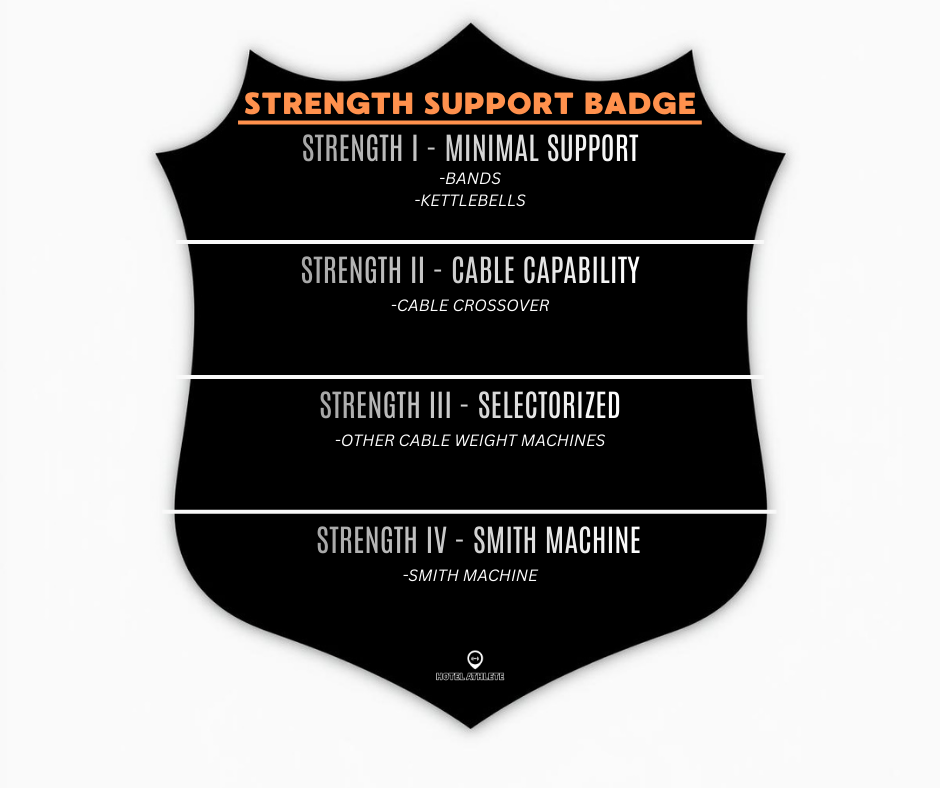
Strength Support Badges
Strength Support badges reflect machine-based strength training options beyond dumbbells.
Strength Support I — Minimal Support
Typical equipment:
• resistance bands
• kettlebells
Supports:
• accessory strength work
• movement-based training
Strength Support II — Cable Capability
Typical equipment:
• cable crossover machine
Supports:
• versatile strength exercises
• upper body training variety
Strength Support III — Selectorized Machines
Typical equipment:
• weight stack machines
Examples:
• lat pulldown
• leg press
• chest press machine
Supports:
• traditional machine-based strength training
Strength Support IV — Smith Machine
Typical equipment:
• Smith machine
Supports:
• heavier compound movements
• squats
• presses
• lunges
This badge significantly expands strength training options.
Functional Training Badges
These badges identify tools that support movement-based and athletic training.
Functional I — Basic Tools
Typical equipment:
• stability ball
• BOSU ball
• medicine balls
Supports:
• core training
• balance work
• light conditioning circuits
Functional II — Bodyweight Infrastructure
Typical equipment:
• pull-up bar
• TRX or suspension trainer
Supports:
• bodyweight strength training
• suspension training
Functional III — Explosive Tools
Typical equipment:
• plyometric jump box
• agility tools (ladder, hurdles)
Supports:
• power training
• speed and agility work
Functional IV — Athletic Zone
Typical equipment:
• turf strip
• dedicated training space
Supports:
• sled pushes
• agility drills
• athletic conditioning
This represents the highest level of functional training capability.

Why the Badge System Matters
Two hotels might both be Level 3 gyms in terms of dumbbell weight.
But their training environments could be very different.
Example:
Hotel A
Level 3
Conditioning I
Strength Support I
Functional I
Hotel B
Level 3
Conditioning III
Strength Support III
Functional II
Even though the dumbbell range is the same, Hotel B supports a much wider variety of workouts.
Understanding the badges helps travelers choose hotels that match their training style and goals.
Reflection
Think about the type of training you prefer while traveling.
Do you usually prioritize:
• cardio and conditioning
• strength training
• functional movement
Knowing your preferences can help you look for hotels with the badge capabilities that support your training style.
Exercise
Evaluate the Badges
Hotel Gym Equipment List:
• treadmill
• spin bike
• rower
• dumbbells up to 45 lbs
• cable crossover machine
• pull-up bar
Question:
What badge levels would this gym receive?
Conditioning
Strength Support
Functional
Correct Evaluation:
Conditioning: Level III — Performance
(because a rower is present)
Strength Support: Level II — Cable Capability
(because of the cable crossover)
Functional: Level II — Bodyweight Infrastructure
(because of the pull-up bar)
Homework
On your next trip, try to identify at least one badge in each category when you visit a hotel gym.
Ask yourself:
• What conditioning tools are available?
• What strength machines are present?
• Are there functional training tools or space?
With a little practice, you’ll begin evaluating hotel gyms in under 60 seconds.
Section 4 – How to Research Hotel Gyms Before Your Trip
A few minutes of research before your trip can dramatically improve your ability to train while traveling.
Many travelers assume hotel gyms are unpredictable, but in most cases you can get a very accurate picture of the gym setup before you arrive.
The key is knowing where to look and what to look for.
Step 1: Start With the Hotel Website
Most hotels include photos of their fitness center somewhere on their website.
Look for sections labeled:
• Fitness Center
• Wellness
• Amenities
• Health Club
These photos can give you your first clues about the gym level and capabilities.
When reviewing images, look specifically for:
• the dumbbell rack (to estimate the maximum weight)
• benches or racks
• cable machines or weight machines
• cardio equipment types
Even one clear photo can help you estimate the Free Weight Level and potential capability badges.
It is useful to note that many hotels use either generic brand photos (not of their gym) or images that are out of date. Following up with the next steps is key for accuracy and verification.
Step 2: Search Guest Photos
Hotel marketing photos often show the gym at its best, but guest photos can reveal the real setup.
Platforms with guest photos often include:
• travel review sites
• map search results
• travel forums
Search terms that can help include:
[Hotel Name] gym
[Hotel Name] fitness center
[Hotel Name] gym photos
Guest photos are especially useful for spotting:
• dumbbell weight ranges
• additional machines
• functional space
Sometimes travelers photograph the entire equipment rack, which makes evaluation very easy.
Step 3: Use Search Engines and Community Forums
If photos are limited, broader search tools can help.
Search engines and online communities sometimes contain firsthand traveler experiences.
Helpful search queries include:
[Hotel Name] gym equipment
[Hotel Name] fitness center review
[Hotel Name] workout
Community forums and discussion sites often include travelers sharing unexpected details about hotel gyms.
While these sources can be helpful, keep in mind that equipment may change over time, so use them as supporting information rather than definitive answers.
Step 4: Explore Hotel Gym Databases
Several platforms track hotel gym equipment and allow travelers to search gyms before booking.
These platforms typically collect information in one of several ways:
• traveler submissions
• manual research
• equipment lists provided by hotels
Different platforms organize their ratings in different ways.
Some systems emphasize:
• overall gym quality ratings
• star-style scoring systems
• equipment checklists
Others use structured systems based on specific equipment categories or strength capabilities.
For example, some systems may rank gyms by general quality, while others classify gyms based on equipment availability and training potential.
Both approaches can be useful depending on what information you’re looking for.
Comparing Research Approaches
Star Ratings or General Reviews
Pros:
• quick snapshot of overall gym quality
• simple for travelers to understand
Cons:
• doesn’t always reveal specific equipment
• may not reflect training potential
Equipment Lists
Pros:
• detailed view of available tools
• helpful for planning workouts
Cons:
• may be incomplete or outdated
• requires more interpretation
Structured Evaluation Systems
Pros:
• faster understanding of training potential
• easier comparison between hotels
Cons:
• may simplify complex equipment setups
Using multiple sources together often provides the most accurate picture.
Step 5: Contact the Hotel Directly
If you cannot find reliable information online, contacting the hotel directly can be surprisingly effective.
Many front desks or concierge teams are happy to help travelers understand their amenities.
You can ask simple questions such as:
• What is the heaviest dumbbell in the gym?
• Do you have a squat rack or barbell?
• Is there a cable machine or weight machines?
You can also request photos of the fitness center.
In many cases, hotel staff can quickly provide a few pictures or a short description, which can give you everything you need to evaluate the gym.
Research Checklist
When researching a hotel gym, try to answer three simple questions:
1️⃣ What is the heaviest dumbbell available?
2️⃣ What conditioning equipment is present?
3️⃣ Are there functional training tools or space?
These answers allow you to estimate:
• Free Weight Level
• Conditioning Badge
• Strength Support Badge
• Functional Badge
Even limited information can usually reveal most of what you need to know.
Reflection
Think about the next trip you have planned.
Before booking or arriving, take five minutes to research the hotel gym using the strategies above.
What clues can you find about:
• dumbbell weight range
• conditioning equipment
• strength machines
You may be surprised how much information is available with a quick search.
Homework
For your next trip, try this Hotel Gym Research Process:
1️⃣ Check the hotel website photos
2️⃣ Look for guest photos online
3️⃣ Run a quick equipment search
4️⃣ Contact the hotel if needed
Your goal is to estimate the Free Weight Level and at least one capability badge before you arrive.
Exercise
Gym Research Simulation
If you were to find the images below online for your upcoming hotel stay, estimate (each image is of a different hotel):
• Free Weight Level
• Conditioning Badge
• Strength Support Badge
• Functional Badge
We can’t tell everything from just one image, but list what you can from what is available.
(Answers below)

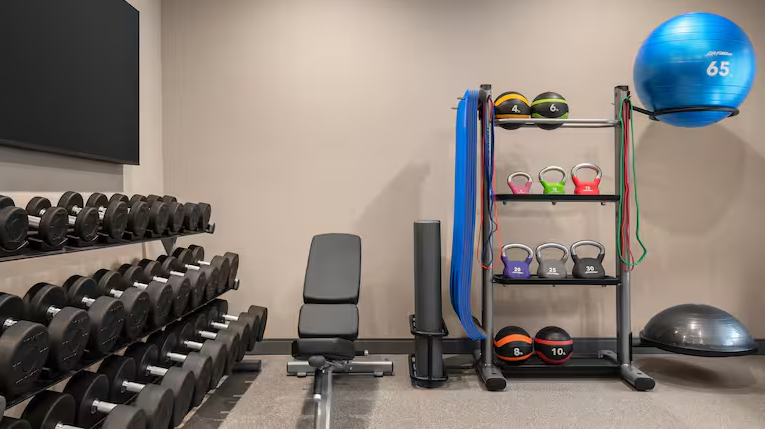

Image 1:
Level: 3 (up to 45 lb dumbbells potentially)
Conditioning: I (treadmills, elliptical, seated bike)
Strength Support: N/A
Functional: N/A
Image 2:
Level: 5 (up to 75 lb dumbbells potentially)
Conditioning: N/A
Strength Support: I (bands, kettlebells)
Functional: I (medicine balls, stability ball, BOSU ball)
Image 3:
Level: N/A
Conditioning: I (treadmills, ellipticals, bike)
Strength Support: N/A
Functional: N/A
Section 5 — Evaluating a Gym When You Arrive
Sometimes the gym isn’t exactly what you expected.
When that happens, follow a quick three-step evaluation.
Step 1 — Identify Strength Equipment
Look for:
• dumbbells
• benches
• cables
• machines
Step 2 — Check Movement Space
Is there room for:
• lunges
• core work
• mobility exercises
Step 3 — Identify Conditioning Options
Look for:
• treadmill
• bike
• rower
Within a few minutes, you’ll know exactly what types of workouts the space supports.
Now you can apply what you learned in Module 7 on building a workout to support your goals with the equipment that you have available.
Reflection
Imagine arriving at a hotel gym that looks different than expected.
Instead of feeling frustrated, ask yourself:
• What strength equipment is available?
• Is there space for movement?
• What conditioning options exist?
This quick mental checklist allows you to adapt your training within minutes.
Homework
On your next trip, walk into the hotel gym and perform the three-step evaluation described in this section.
Take 2 minutes to identify:
1️⃣ strength equipment
2️⃣ movement space
3️⃣ conditioning options
Then mentally design a workout using the framework from Module 7.
Section 6 — When the Gym Isn’t What You Expected
Even the best planning can’t predict every travel situation.
Equipment may be missing or different from the photos you saw.
When that happens, remember the framework from Module 7:
movement patterns matter more than specific exercises.
If you planned:
Squats → use goblet squats
Bench press → use push-ups
Pull-ups → use rows
Adapting exercises while maintaining the structure keeps your training consistent.
Reflection
Think about a time when travel disrupted your workout plan.
Did the disruption happen because:
• equipment was missing
• time was limited
• the gym was smaller than expected
Recognizing these patterns helps you prepare better for future trips.
Module 8 Homework
Hotel Gym Recon Mission
We’re assigning you a few “next trips”.
We’ll provide a couple of locations and your workout goals.
Click the link to our database and find a hotel that fits each scenario (there will likely be more than one option).
Scenario 1:
Destination: Salt Lake City general area
Your training goals: Need 75 lb dumbbells for strength training; need plyometric jump box for performance work
Hotel: ____________________________________________
Scenario 2:
Destination: Denver general area
Your training goals: Medium dumbbells up to 45 lb for mobility work; need rower or air bike for VOmax training
Hotel: _____________________________________________
Scenario 3:
Destination: Chicago general area
Your training goals: Peloton or Spin Cycle for VO2 work; set of 50 lb dumbbells for unilateral lower body training
Hotel: _______________________________________________
Module 8 Key Takeaways
Hotel gyms vary widely, but with the right approach you can quickly determine what type of training environment you’re working with.
The goal is not to find the perfect gym — it’s to understand what the space allows you to do.
1. Start With the Free Weight Level
The heaviest dumbbell in the gym is often the fastest way to estimate the gym’s strength potential.
The Free Weight Level System classifies gyms from:
Level 1 — No free weights
to
Level 7 — Barbell and rack available
Knowing the free weight ceiling helps you quickly understand how much strength training the gym supports.
2. Use Capability Badges to Understand Training Variety
Badges provide a deeper look at what types of training the gym supports.
Hotel Athlete evaluates three capability categories:
• Conditioning
• Strength Support
• Functional Training
Each category has four levels based on the equipment available.
Remember: any equipment from a higher badge level qualifies the gym for that level.
3. A Few Minutes of Research Can Save a Workout
Before your trip, spend a few minutes researching the hotel gym.
Helpful strategies include:
• checking the hotel website photos
• reviewing guest photos online
• searching forums and travel discussions
• exploring hotel gym databases
• contacting the hotel directly if needed
Even limited information can usually reveal the gym’s level and key capabilities.
4. Not All Level 3 Gyms Are the Same
Two gyms may have the same dumbbell range but offer very different training environments.
Example:
One gym may only support basic cardio and dumbbells.
Another may include:
• rowers
• cable machines
• pull-up bars
• functional space
The capability badges reveal these differences.
5. Flexibility Is the Real Skill
The best traveling athletes don’t depend on perfect equipment.
They develop the ability to:
• evaluate a gym quickly
• understand what training it supports
• adapt their workouts accordingly
This mindset allows you to stay consistent no matter where you travel.
Module 8 Quiz
Evaluating Your Hotel Gym Situation
Test your understanding of evaluating your hotel gym prior to your trip, as well as on the fly when you arrive.
What Comes Next
Now that you understand how to evaluate hotel gyms and identify what type of training they support, the next step is learning how to design a nutrition strategy that supports your training while traveling.
Travel schedules, restaurant meals, and limited kitchen access can make nutrition difficult to manage.
In the next module, you’ll learn how to build a flexible travel nutrition system that works in hotels, airports, and restaurants.
Next Module
Module 9: Travel Nutrition Systems
Learn how to build a repeatable approach to fueling your body during travel without relying on strict meal plans.
MODULES
Module 1 — The Travel Health Problem
Why traditional workout plans fail during travel.
Module 2 — The PROF Framework
Understanding the cycle that powers healthy travel.
Module 3 — Perform
How to train effectively in unpredictable environments.
Module 4 — Reflect
The fastest way to improve your travel routine.
Module 5 — Optimize
Small adjustments that dramatically improve travel health.
Module 6 — Fuel
Nutrition and recovery strategies for life on the road.
Module 7 — Travel Fitness Systems
Build repeatable workout systems that adapt to your environment.
Module 8 —
Choosing the Right Hotel Gym
A strategy to choosing your gym around your plan.
Module 9 — Travel Nutrition Systems
Creating repeatability and reducing decision fatigue.
Module 10 — Travel Recovery
The essential focal points to allowing your body to maintain its energy during travel.