
PROF Learning Center
Module 5: Optimize
Travel rarely happens under perfect conditions.
Flights get delayed. Hotel gyms vary widely. Meetings change your schedule.
The travelers who maintain consistency don’t rely on rigid routines—they build systems that adapt to travel.
This is the purpose of Optimize in the PROF framework.
Reflection helps you understand your experiences. Optimization helps you use those insights to improve your strategy.
Optimization happens on two levels:
Short-term optimization
Adjusting your decisions day-to-day during a trip.
Long-term optimization
Improving your travel strategies across multiple trips.
In this module you’ll learn how to:
• adjust your routine during travel
• design strategies that reduce friction
• build a personal system that supports healthy travel long-term
Optimization is what allows the PROF cycle to continuously improve over time.
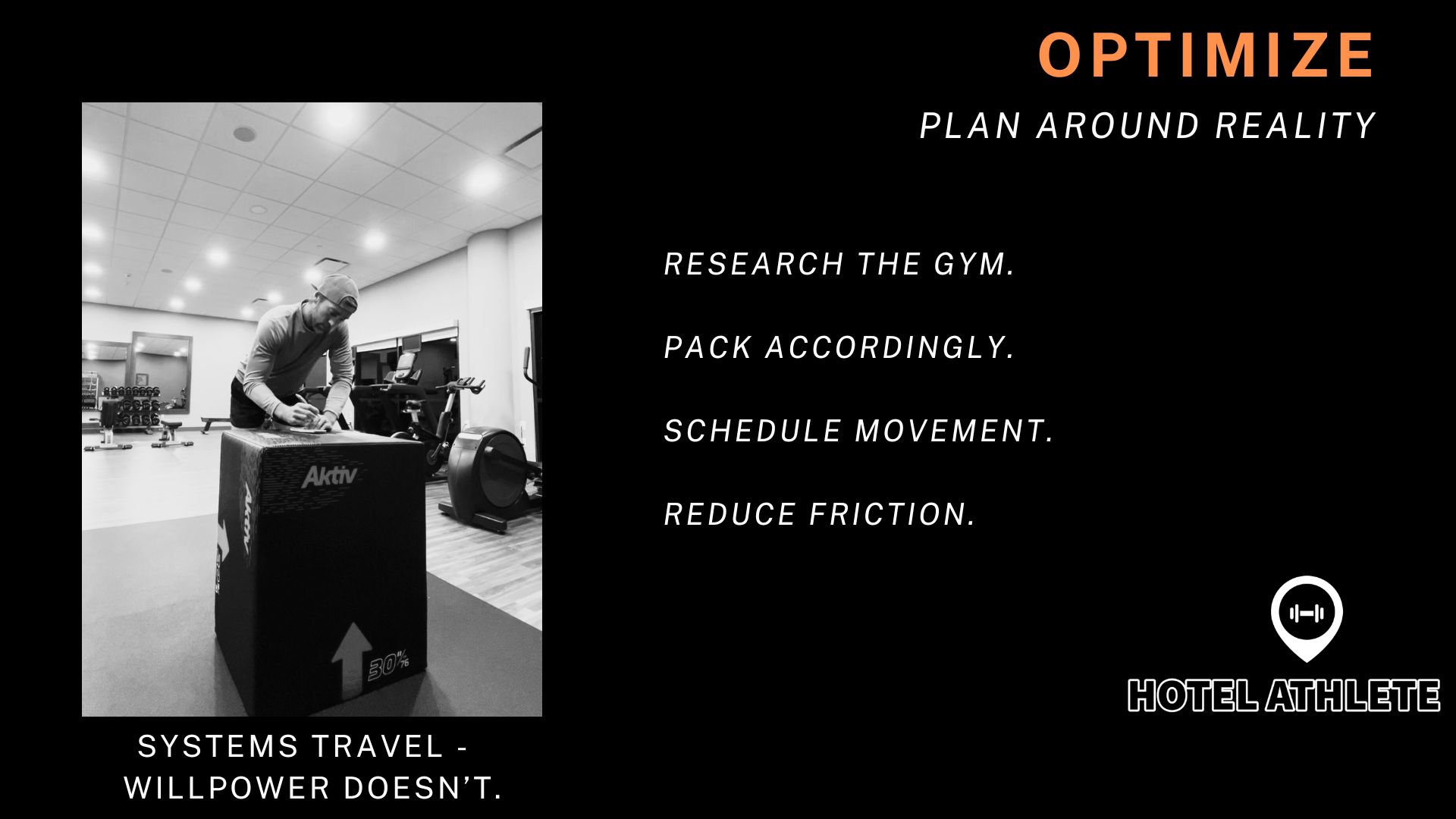
Section 1 — Optimization Is Not Perfection
Many people believe optimizing their routine means building the perfect plan.
But travel doesn’t work that way.
Instead of searching for the perfect routine, successful travelers focus on adaptability.
Optimization means improving your system so that healthy decisions become easier in real travel environments.
Examples of optimization include:
• choosing hotels with better gym equipment
• adjusting workout timing around meetings
• planning movement into travel days
• identifying reliable food options
These small adjustments create better conditions for healthy behavior.

Homework
Think about one friction point you identified in the Reflect module.
Ask yourself:
What small change could make this situation easier next time?
Write your answer:
_________________________________________
Section 2 — Short-Term Optimization: Adjusting During the Trip
Optimization doesn’t only happen after travel.
You can also make adjustments in real time during a trip.
This is called short-term optimization.
Examples include:
• shortening a workout when time is limited
• switching from a gym workout to a walking session
• adjusting meal timing during long travel days
The goal is to maintain momentum rather than perfection.
Instead of asking:
“Can I do my full routine today?”
Ask:
“What is the best healthy action I can take right now?”
Small actions keep the system moving forward.
Interactive Exercise
The 10-Minute Optimization Rule
During travel, ask yourself:
If I only had 10 minutes, what would I do?
Examples:
10-minute bodyweight circuit
10-minute walk around the hotel
10-minute mobility session
Write your personal 10-minute travel reset:
This strategy helps prevent all-or-nothing thinking during travel.
Section 3 — Long-Term Optimization: Improving Future Trips
Short-term adjustments help during travel.
But the most powerful improvements come from optimizing future travel environments.
This is where reflection becomes strategy.
Instead of accepting travel conditions as fixed, you begin designing better travel environments.
Examples include:
Choosing hotels based on gym equipment
Selecting flights that protect sleep schedules
Identifying reliable healthy restaurant options
Over time, these choices reduce friction and support consistent habits.
Homework
Think about your next upcoming trip.
What is one thing you could improve in advance?
Examples:
Hotel selection
Workout planning
Food preparation
Write your answer:
Section 4 – Pre-Trip Optimization: Design the Environment Before You Travel
One of the biggest mistakes travelers make is trying to make healthy decisions after they arrive.
By that point, options are limited.
Airport food choices are fixed.
Hotel gyms are already chosen.
Schedules are already full.
High-performing travelers approach this differently.
They optimize their environment before leaving home.
A small amount of preparation can dramatically increase the likelihood that healthy habits happen during the trip.
Instead of reacting to travel, you begin designing travel conditions that support success.
The Pre-Trip Optimization Checklist
Before leaving for a trip, review the following areas.
The goal is not perfection — it is simply to remove common friction points before they occur.
1. Pack for Performance First
Many travelers pack business clothing first and squeeze workout gear into whatever space remains.
A better strategy is the opposite.
Pack movement and recovery tools first, then fit business clothing around them.
This eliminates the excuse of “I didn’t bring the gear.”
Pack Checklist
☐ Workout clothing
☐ Training shoes
☐ Resistance bands
☐ Mobility ball or roller
☐ Jump rope (optional travel tool)
If you rely on supplements:
☐ Electrolytes
☐ Protein powder
☐ Travel snacks
☐ Insert your go-to supplement(s)
2. Research the Hotel Gym
Hotel gym quality varies dramatically.
Some gyms support meaningful strength training, while others include little more than cardio equipment.
Before your trip, research the hotel gym to understand what equipment is available.
Look for:
• dumbbell weight ranges
• benches or racks
• available floor space
• cardio equipment
This allows you to plan workouts that actually match the environment.
3. Create Your Travel Workout Plan
Waiting until you arrive at the hotel to decide what workout to do creates friction.
Instead, create a simple travel workout plan before departure.
This might include:
• 2 short hotel gym workouts
• 1 bodyweight workout option
• a walking or running route
Having a plan removes the need to make decisions when time and energy are limited.
4. Research Food Options in Advance
Airport terminals and unfamiliar cities often create decision fatigue around food.
A few minutes of research can dramatically improve your options.
Look up:
• airport restaurant options
• grocery stores near your hotel
• restaurants within walking distance
• healthy menu items in advance
This removes the stress of last-minute food decisions.
5. Prepare for Outdoor Movement
Sometimes the best workout during travel happens outside the hotel gym.
Parks, walking paths, and outdoor spaces can provide excellent training environments.
Before leaving, check:
• local weather
• nearby parks
• running routes
• safe walking areas
This creates additional movement opportunities during the trip.
6. Reduce Common Travel Friction
Finally, think about common situations that disrupt routines.
Examples include:
• long travel days
• late hotel arrivals
• unpredictable schedules
Preparing simple solutions ahead of time helps maintain consistency.
Examples:
Pack snacks to avoid airport food stress.
Schedule a 10-minute movement session on travel days.
Plan shorter workouts when schedules are tight.
Why Pre-Trip Optimization Matters
Many people believe discipline is the key to staying healthy during travel.
But often the difference is simply better preparation.
When your environment supports healthy decisions:
• workouts become easier to complete
• food choices improve
• stress and decision fatigue decrease
Optimization isn’t about doing more work.
It’s about doing the right preparation at the right time.
Homework
Before your next trip, try this packing strategy:
Pack your workout gear first.
Then complete the rest of your suitcase.
Did this change how prepared you felt?
Write a quick reflection:
Planning Exercise
Search for your upcoming hotel.
Answer the following:
Dumbbell weight range available:
Other available equipment:
Does your current workout plan match this equipment?
☐ Yes
☐ No — adjust workout
☐ No — consider alternative hotel
Hint: Try finding your hotel in our Hotel Gym Database
Homework
Write down your next travel workout plan.
Workout 1:
Workout 2:
Backup workout (Plan B):
Interactive Exercise
Search your destination city and identify:
One grocery store near your hotel:
One restaurant with healthy menu options:
One airport option that supports your goals:
Planning Exercise
Check the weather forecast for your destination.
Is outdoor training possible?
☐ Yes
☐ Maybe
☐ Unlikely
If yes, identify a nearby outdoor location:
Reflection
Think about your last trip.
What was the biggest friction point?
What could you do before your next trip to reduce it?
Section 5 — Designing Your Travel Performance System
Optimization works best when you develop a repeatable travel system.
Instead of solving the same problems every trip, you begin building reliable strategies.
Your system might include:
A hotel selection strategy
A simple travel workout framework
A short list of reliable travel meals
A movement plan for travel days
These systems remove decision fatigue and allow you to focus on execution instead of planning.
Interactive Exercise
Build Your Travel System
Complete the following framework.
Movement Strategy
How will you stay active during trips?
Workout Strategy
What type of workouts work best for your travel schedule?
Nutrition Strategy
What simple food strategies support your energy?
Recovery Strategy
What helps you recover and maintain energy during travel?
Over time, these strategies evolve into a personal travel health system.
Section 6 — Optimization Is Continuous
Optimization is not something you do once.
It’s a continuous process.
Every trip provides new information.
Some strategies will work well.
Others will need adjustment.
This is why the PROF system cycles repeatedly:
Perform → Reflect → Optimize → Fuel
Each pass through the cycle makes your travel routine stronger and more reliable.
The goal isn’t perfection.
The goal is progress trip by trip.
Reflection
Think about your upcoming travel schedule.
Answer these questions:
What is one habit you want to maintain during travel?
What is one friction point you want to improve?
What is one optimization you will try next trip?
_________________________________________
Section 7 — Optimization Levels: Developing Your Travel System
Optimization is a skill that improves with experience.
Early in the process, many travelers simply try to fit workouts into busy travel schedules. Over time, they begin refining how they prepare, plan, and structure their trips.
This progression is what separates occasional success from consistent healthy travel.
The goal is not to reach a perfect routine. Instead, the goal is to gradually improve how you prepare for and navigate travel environments.
Below are three common stages of travel optimization.
Level 1: Reactive Traveler
At this stage, most decisions happen after the trip begins.
Travelers try to stay healthy using whatever options are available once they arrive at the airport or hotel.
Common characteristics:
• deciding on workouts once arriving at the hotel
• relying on whatever food options are nearby
• little preparation for movement or recovery
This stage often leads to inconsistent habits, because the environment wasn’t designed to support success.
Level 2: Prepared Traveler
At this stage, travelers begin planning before the trip begins.
They start identifying common friction points and preparing simple strategies to overcome them.
Examples include:
• packing workout gear intentionally
• researching hotel gym equipment
• identifying food options near the destination
• preparing simple workout plans
These travelers are no longer reacting to travel — they are preparing for it.
Consistency begins to improve significantly.
Level 3: The Hotel Athlete
At the highest level, travelers actively design travel environments that support performance.
Instead of simply planning workouts, they optimize the entire travel experience.
Examples include:
• selecting hotels based on gym equipment
• planning workouts that match the available environment
• identifying reliable nutrition strategies
• scheduling movement into travel days
• creating backup workouts when plans change
At this stage, travel becomes part of a repeatable health system rather than a disruption.
This is the mindset behind the Hotel Athlete approach.
Reflection
Think about your current travel habits.
Which level best describes your approach today?
☐ Level 1: Reactive Traveler
☐ Level 2: Prepared Traveler
☐ Level 3: Hotel Athlete
What is one step you could take to move to the next level?
Write your answer:
_________________________________________
Module 5 Key Takeaways
Optimization turns insight into action.
Instead of restarting after each trip, you gradually build systems that work within the realities of travel.
Remember:
• Short-term optimization helps during trips
• Long-term optimization improves future travel
• Small improvements compound over time
Travel doesn’t have to disrupt your health.
With the right strategies, it can actually strengthen your system.
Module 5 Quiz
Building Systems From Feedback
Test your understanding of the Optimize step in the PROF cycle.
What Comes Next
You now understand how to design strategies that support healthy travel.
But even the best system depends on something critical:
Your energy and recovery.
Nutrition, hydration, and sleep play a major role in how well you perform during travel.
The final step of the PROF framework focuses on supporting these foundations.
Next Module
Module 6: Fuel
Learn how to maintain energy, support recovery, and make practical nutrition choices while traveling.
MODULES
Module 1 — The Travel Health Problem
Why traditional workout plans fail during travel.
Module 2 — The PROF Framework
Understanding the cycle that powers healthy travel.
Module 3 — Perform
How to train effectively in unpredictable environments.
Module 4 — Reflect
The fastest way to improve your travel routine.
Module 5 — Optimize
Small adjustments that dramatically improve travel health.
Module 6 — Fuel
Nutrition and recovery strategies for life on the road.
Module 7 — Travel Fitness Systems
Build repeatable workout systems that adapt to your environment.
Module 8 —
Choosing the Right Hotel Gym
A strategy to choosing your gym around your plan.
Module 9 — Travel Nutrition Systems
Creating repeatability and reducing decision fatigue.
Module 10 — Travel Recovery
The essential focal points to allowing your body to maintain its energy during travel.