
PROF Learning Center
Module 7: Travel Fitness Systems
Training Consistently on the Road
Staying active during travel is rarely limited by motivation.
More often, it is limited by inconsistent environments.
Different hotel gyms.
Limited equipment.
Busy schedules.
Unexpected travel delays.
Without a system, workouts become difficult to plan and easy to skip.
The purpose of this module is to help you develop a simple travel fitness system that allows you to train consistently regardless of where you are.
A system removes guesswork and helps ensure that training remains part of your routine—even when travel conditions change.
Section 1 — Why Systems Matter More Than Motivation
Many travelers approach workouts with good intentions but no clear structure.
They arrive at the hotel gym and try to decide what to do in the moment.
This approach often leads to:
• inconsistent workouts
• wasted time deciding exercises
• skipped training sessions
A fitness system removes these barriers.
Instead of deciding what to do each day, you simply follow a repeatable structure.
This reduces mental effort and makes it easier to maintain consistency during travel.

Reflection
Think about your last hotel gym workout.
Did you already have a workout planned before arriving?
☐ Yes
☐ No
How much time did you spend deciding what to do once you arrived?
_________________________________________
Section 2 — The Travel Workout Structure
A simple structure can work in nearly any training environment.
The Hotel Athlete approach organizes workouts into five basic phases:
- Warm-up
- Performance or power work
- Strength training
- Core or conditioning
- Cool down
This structure ensures that each workout addresses multiple aspects of physical performance while remaining adaptable to available equipment.
Even when equipment changes, the structure of the workout remains consistent.
Example Structure
Warm-up → mobility or light cardio
Performance → explosive movement (jumps, throws, sprints)
Strength → compound exercises
Core/Conditioning → trunk stability or short conditioning work
Cool down → mobility or recovery work
Section 3 — Adapting to Different Hotel Gyms
Hotel gyms vary dramatically in equipment availability.
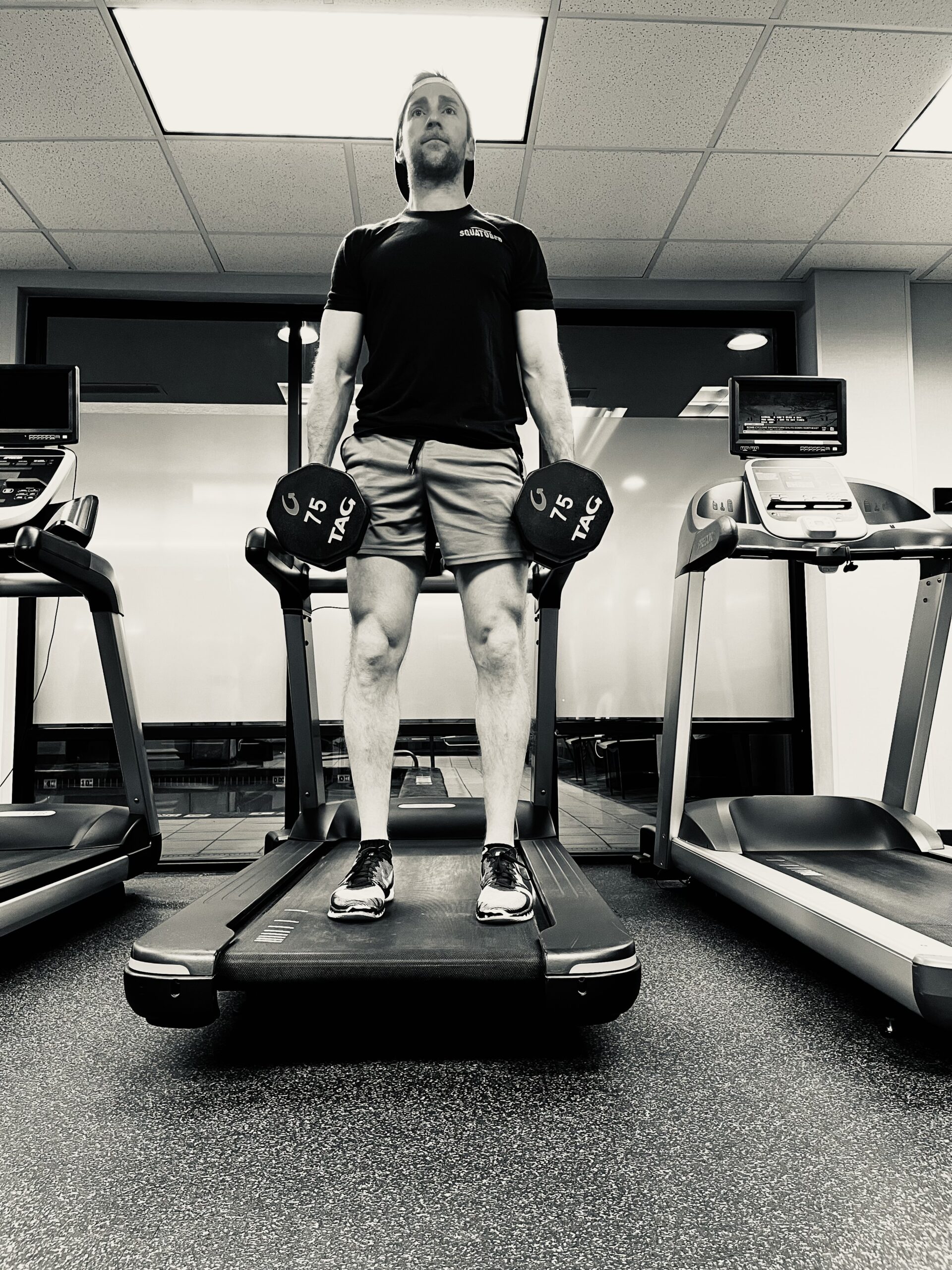
Some may offer full weight rooms, while others provide only a few dumbbells and a treadmill.
Instead of expecting a perfect gym, successful travelers learn to adapt their workouts to the environment.
A helpful strategy is to think in movement patterns rather than specific exercises.
For example:
Lower body push → squat or step-ups
Lower body hinge → deadlift or hip bridge
Upper body push → pushups or dumbbell press
Upper body pull → rows or pull-ups
By focusing on movement patterns, you can substitute exercises easily when equipment changes.
Exercise
Think about your favorite lower-body exercise.
What is one alternative you could perform if that equipment was unavailable?
Primary Exercise:
Alternative:
Section 4 – Planning Workouts Before You Travel
One of the most effective strategies for maintaining travel fitness is planning workouts before the trip begins.
This is part of the Optimize phase of the PROF framework.
Before traveling, consider:
• what equipment your hotel gym may have
• how many training days are realistic
• the length of your workouts
Planning even two or three workouts ahead of time dramatically increases the likelihood that they will happen.
When you arrive at the hotel, the decision has already been made.
Planning
Before your next trip, write down:
How many workouts you plan to complete:
Estimated workout length:
Section 5 — Time-Efficient Travel Workouts
Travel schedules are often unpredictable.
For this reason, shorter workouts are often more effective than long sessions that are difficult to fit into busy days.
Many travelers find success with 20–30 minute workouts.
Short workouts can still include:
• strength exercises
• conditioning intervals
• mobility work
Consistency is far more important than workout length.
Even brief training sessions help maintain strength, mobility, and energy levels during travel.
Reflection
What workout duration feels most realistic for your travel schedule?
15 minutes
20 minutes
30 minutes
45 minutes
Write your preferred travel workout length:
Section 6 — Consistency Beats Intensity
When traveling, the goal is not to create the hardest workout possible.
The goal is to maintain consistent movement and training habits.
Trying to push maximum intensity during every travel workout can lead to fatigue, soreness, or missed sessions.
Instead, aim for workouts that feel productive while leaving you energized for the rest of your day.
Consistency across multiple travel days often produces better results than occasional high-intensity sessions.
Reflection
Which approach better supports your travel routine?
☐ Shorter, consistent workouts
☐ Occasional long workouts
Why?
Section 7 — Building Your Personal Travel Fitness System
A personal travel fitness system combines several simple strategies:
• a consistent workout structure
• adaptable exercises
• realistic workout duration
• basic pre-trip planning
Together, these elements make it easier to maintain fitness habits even when travel environments change.
Over time, this system becomes automatic.
Instead of wondering whether you will train during travel, the expectation becomes simple:
Travel includes training.
This mindset is part of what defines a Hotel Athlete.
Reflection
What is one step you could take to improve your travel workout consistency?
Examples might include:
planning workouts before travel
shortening workout length
identifying alternative exercises
Write your answer:
_________________________________________
Section 8 — Real-World Travel Workout Scenarios
Travel rarely goes exactly as planned.
You might arrive at the gym expecting one setup and discover something completely different.
The key to maintaining consistency is learning how to adapt your workout while keeping the overall structure intact.
Below are several common travel scenarios and how a Hotel Athlete can adjust while still completing an effective workout.
Scenario 1
The Unexpected Hotel Gym
You researched the hotel gym before your trip and expected a full dumbbell rack and several strength machines.
When you arrive, you discover that the gym has:
• dumbbells up to 40 lbs
• a treadmill
• a cable machine
Several machines you expected are missing.
Step 1: Keep the Workout Structure
Instead of abandoning your workout plan, keep the framework:
Warm-up
Performance
Strength
Core/Conditioning
Cool down
Step 2: Adjust the Exercises
Original plan:
Lower push → Barbell squat
Upper push → Bench press
Upper pull → Pull-ups
Adapted plan:
Lower push → Goblet squats
Upper push → Dumbbell floor press
Upper pull → Cable rows
The movement pattern stays the same, even though the exercise changes.
Scenario 2
No Research, No Plan
You arrive at the hotel gym with no idea what equipment is available.
The gym contains:
• treadmill
• adjustable bench
• dumbbells
Step 1: Identify Movement Patterns
Look for exercises that cover the major patterns:
Lower body push
Lower body hinge
Upper body push
Upper body pull
Core
Step 2: Build a Quick Workout
Example:
Warm-up
5 minutes treadmill walk or jog
Strength
Dumbbell goblet squat
Dumbbell Romanian deadlift
Dumbbell bench press
Dumbbell rows
Core
Plank variations
Even with minimal planning, a strong workout is still possible.
Scenario 3
Broken Equipment
You planned to perform:
• dumbbell bench press
• pull-ups
• split squats
But when you arrive:
• the bench is broken
• the pull-up bar is unavailable
Adapt the Exercises
Bench press → Push-ups
Pull-ups → Inverted rows or cable rows
The workout structure remains intact.
Scenario 4
Minimal Equipment Gym
Some hotel gyms contain only:
• treadmill
• exercise bike
• yoga mats
Focus on Bodyweight Training
Example:
Warm-up
5 minutes incline walk
Strength circuit
Bodyweight squats
Push-ups
Walking lunges
Glute bridges
Core
Planks
Side planks
Interactive Exercise
Scenario: Limited Hotel Gym
You arrive at a hotel gym and find the following equipment available:
• Dumbbells
• Adjustable bench
• Treadmill
• Floor space
Using the Hotel Athlete workout framework, build a quick workout by selecting exercises for each movement pattern.
At the end, we’ll show you what your finished travel workout could look like.
Module 7 Key Takeaways
Maintaining fitness during travel becomes easier when you rely on systems rather than motivation.
Key principles include:
• follow a consistent workout structure
• adapt exercises to available equipment
• plan workouts before your trip
• prioritize consistency over intensity
A simple system allows you to stay active in almost any travel environment.
Module 7 Quiz
Building Your Travel Fitness System
Test your understanding of the methology behind building a consistent workout plan despite any challenges presented by travel.
What Comes Next
In this module, you learned how a simple workout structure can help you train consistently during travel—even when equipment and schedules change.
By focusing on movement patterns, adaptable exercises, and realistic workout durations, you can maintain a reliable training routine in almost any environment.
However, one factor still plays a major role in the quality of your travel workouts:
The hotel gym itself.
Some hotel gyms provide a wide range of equipment that allows for complete strength workouts, while others offer only minimal options.
Learning how to quickly evaluate a hotel gym—and understand what types of workouts it supports—can help you plan more effectively before your trip even begins.
In the next module, we’ll introduce a simple framework for evaluating hotel gyms and identifying what types of workouts they can support.
You’ll learn how to:
• assess hotel gym equipment quickly
• identify what type of workout environment you’re working with
• adapt your workout plan based on available equipment
Next Module
Module 8: Choosing the Right Hotel Gym
Learn how to evaluate hotel gyms using the Hotel Athlete Gym Level System, and discover strategies for finding reliable workout environments before you travel.
MODULES
Module 1 — The Travel Health Problem
Why traditional workout plans fail during travel.
Module 2 — The PROF Framework
Understanding the cycle that powers healthy travel.
Module 3 — Perform
How to train effectively in unpredictable environments.
Module 4 — Reflect
The fastest way to improve your travel routine.
Module 5 — Optimize
Small adjustments that dramatically improve travel health.
Module 6 — Fuel
Nutrition and recovery strategies for life on the road.
Module 7 — Travel Fitness Systems
Build repeatable workout systems that adapt to your environment.
Module 8 —
Choosing the Right Hotel Gym
A strategy to choosing your gym around your plan.
Module 9 — Travel Nutrition Systems
Creating repeatability and reducing decision fatigue.
Module 10 — Travel Recovery
The essential focal points to allowing your body to maintain its energy during travel.